Decision-making is complex. Just ask the land manager deciding whether a controlled burn or timber harvesting is the best approach to reduce wildfire risk in a particular area, or the business leader evaluating if AI chatbots help or harm client relationships. They’ll tap into their training, expertise, and technical knowledge, but they’ll also rely on critical thinking and other human-centric skills to inform their decisions and navigate the implications.
Employers across industries increasingly need candidates with these higher-order skills to stay competitive and flexible in an ever-evolving world. The graduates today who can demonstrate strong communication, problem solving abilities, collaboration, and more will thrive in the jobs and technologies of tomorrow—even ones yet to exist.
To ensure graduates succeed professionally and academically—not to mention “future-proof” their institutions—higher education leaders must also adapt, guiding their faculty to teach, nurture, and assess higher-order thinking and learning.
Engaging students in real-world scenarios gives students, faculty, institutions, and even future employers an edge. When institutions empower faculty to integrate timely and relevant dilemmas into learning:
- Students build essential higher-order skills that immediately transfer into the workplace and life outside of the lecture hall, regardless of their major or field of study.
- Faculty increase student engagement and improve their readiness to enter the workforce.
- Institutions graduate more skilled candidates for the workforce, demonstrating the relevance of their degrees and boosting their reputation.
- Employers confidently hire graduates, knowing they possess the skills needed to move through ambiguity and flex in response to changing demands and technologies.
CAE offers higher education institutions a comprehensive programto support the integration of critical thinking into every course of study, from associate to Ph.D. programs. Our Critical Thinking Skills Program provides:
- Professional development that equips educators to effectively teach higher-order skills as part of existing courses.
- Instructional materials that teach students a framework for effective critical thinking and provide opportunities to practice using critical thinking skills in real-world situations specific to their course of study.
- Performance-based assessments that measure proficiency, track growth, and showcase real-world readiness.
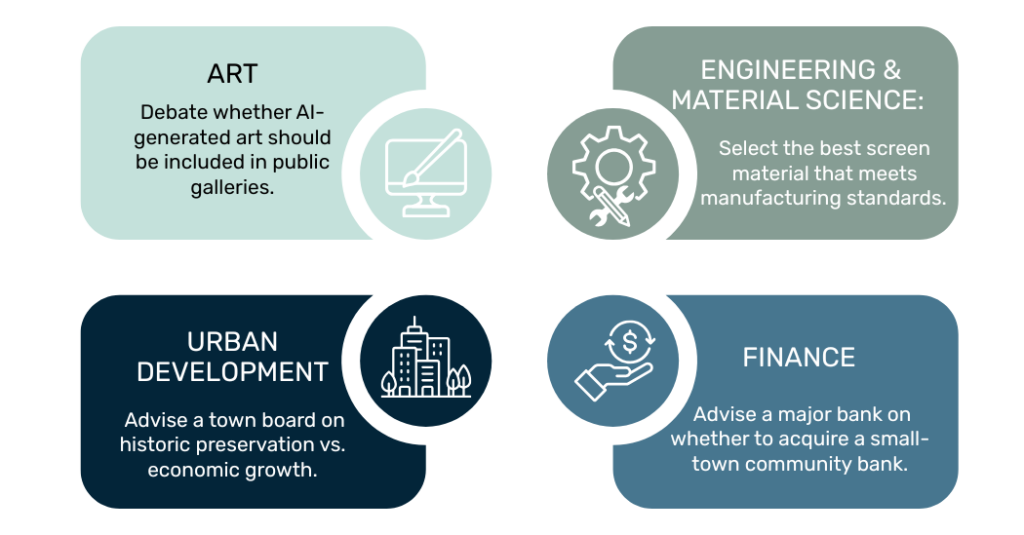
The practice scenarios included in the program cover relevant issues in business, social sciences, STEM, and the humanities and can be customized to mirror your community’s industries, challenges, and goals. In each scenario, students analyze evidence, weigh priorities, take a position, and communicate their solutions clearly—just like employers will expect them to.
Want to equip your students to make real-world decisions with confidence?
At CAE, we help higher education institutions develop students’ higher-order skills through real-world practice—not just theory. Our Critical Thinking Skills Program integrates seamlessly into any course of study, empowering students to:
-
Analyze complex, real-life scenarios using evidence and logic
-
Communicate clearly, collaborate effectively, and make sound decisions
-
Enter the workforce ready to solve problems, adapt, and lead in evolving environments