As businesses seek to adapt to AI and technological advancements, economic and geopolitical shifts, and evolving customer needs, employers are increasingly seeking to hire candidates who have not only strong technical knowledge, but also the ability to think critically, problem solve, innovate, and communicate effectively.
Recognizing this trend, Texas A&M University’s Mays Business School (Mays) partnered with the Council for Aid to Education (CAE) to integrate CAE’s Critical Thinking Skills Program into its curriculum. Over the past five years, this initiative has trained thousands of Mays students in the workforce skills that 95% of students believe are vital to their future success1 and that employers say matter most—critical thinking (79%), problem solving (74%), and written communication (77%).2
Through its innovative pedagogical program and measurable impact, Mays is raising the bar for career readiness for higher education students.
The Current Landscape
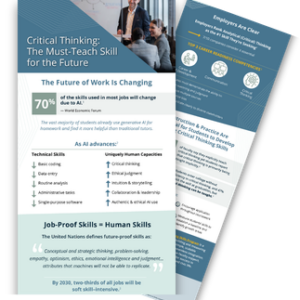
Employers repeatedly cite critical thinking and problem solving as the skills they value most. Yet, 60% of hiring managers say graduates don’t have these skills.3 Research conducted by CAE and the OECD confirms this, finding that upon graduation only 53% of students are proficient in critical thinking, problem solving, and written communication.4
Additionally, based on CAE’s research, higher education students who perform better on CLA+, a performance-based assessment of critical thinking and effective communication, are more likely to have positive post-higher education outcomes as measured by employment, salary, and graduate school enrollment. They are also more likely to have higher evaluations from their managers and advisors.5
Embedding Critical Thinking Instruction into Existing Courses
In response to the research and employers’ needs, Mays strengthened its pedagogy and began intentionally teaching and measuring students’ critical thinking skills using CAE’s Critical Thinking Skills Program.
Professional Development
Explicitly teaching higher-order skills was new to most Mays faculty. CAE led professional development workshops to guide faculty in embedding intentional critical thinking instruction and opportunities for deliberate practice into existing coursework. Program champions among Mays faculty have driven broader adoption.
“With CAE’s guidance, weaving critical thinking into our curriculum has been both straightforward and impactful. Students now see these skills as central to their success, not just add-ons.”
~Dr. Kyle Gammenthaler, Clinical Assistant Professor, Texas A&M
Critical Thinking Skills Instruction
All incoming Mays undergraduate students are taught CAE’s seven-step framework for effective critical thinking and given opportunities to use the framework with multiple performance tasks embedded in the core courses across the Mays program. These performance tasks, tied to the course content, place students in realistic scenarios that require them to make a decision with incomplete, ambiguous, and biased information-mirroring the challenges they will face in the real world.
“Even before starting my career, I’ve seen how critical thinking makes a difference. In interviews, I was able to show not just what I know, but how I think—and that stood out to employers.”
~Student, Mays Business School
Actionable Insights
CAE’s performance-based assessment, CLA+, is used to measure students’ skills prior to graduation and at other points during their tenure at Mays. Students receive personalized reports to help them understand their current skill levels and identify ways to improve. Mays faculty receives aggregated data and reports to support continuous improvement.
 Demonstrated Results
Efficacy studies show statistically significant improvements through the use of CAE’s Critical Thinking Skills Program:
- 4th-year students who had classroom instruction on critical thinking performed statistically significantly higher on CLA+.6
 Analyses of CLA+ results for a cohort of 179 Mays graduate students showed that increasing the level of curricular instruction led to a statistically significant increase in students’ CLA+ Scores.
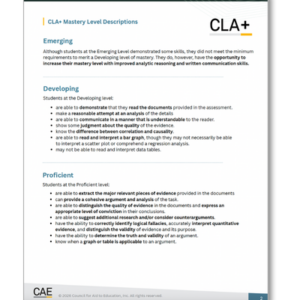
As instruction increased, proportionally more students reached the top two mastery levels (Accomplished or Advanced), while fewer were at the Below Proficiency level.
Curriculum-Wide Expansion
CAE’s Critical Thinking Skills Program is now embedded in every core business course through a redesigned curriculum-an approach that reflects the success of the program at Mays. The results at Mays show that the greatest gains occur when critical thinking is intentionally taught and practiced. The initial program for Mays undergraduates has expanded to include graduate students, reinforcing the need for higher-order skill development at all levels of study.
“Employers consistently tell us they want graduates who can think, solve, and lead. We’ve expanded CAE’s Critical Thinking Skills Program to most graduate business students to ensure they develop those skills—and it shows when they enter the job market.”
~Mike Alexander, Assistant Dean for Graduate Programs, Mays Business School
The Results: A Scalable Model with Proven Impact
- Broad impact as each year ~1,200 entering undergraduate business students receive instruction in CAE’s Critical Thinking Skills Framework and over 1,400 students receive deliberate practice through multiple content-aligned performance tasks embedded in core courses and graduate.
- Statistically significant gains in the skills most in-demand by employers and predictive of positive academic and post-graduation outcomes.
- Faculty champions driving curriculum-wide integration and expansion to sustain and scale the With the expansion of the Critical Thinking Skills Program to Mays graduate students, these numbers and the program impact will continue to increase.
What’s Next
With a redesigned curriculum, expanded program offerings, and ongoing research exploring the link between critical thinking proficiency and career outcomes, Mays continues to strengthen its position as a leader in preparing workforce-ready graduates.
“This initiative has boosted student success, faculty satisfaction, and employer interest. It’s rare to find a program that makes such a clear impact across every part of the university experience.”
~Dr. Shannon Deer, Associate Dean for Undergraduate Programs, Mays Business School
1, 6 Zahner, D., Gammenthaler, K., Dawber, T., & Cortellini, O. (2026). Measuring and Improving University Students’ Critical Thinking Skills through Assessment and Instruction. DIDAC, (87), 8-26.
2, 3 Finley, A. P. (2023). The career-ready graduate: What employers say about the difference college makes. American Association of Colleges and Universities.
4, 5 Zahner, D., & Van Damme, D. (Eds.). (2022). Does higher education teach students to think critically? OECD Publishing. https://doi.org/10.1787/cc9fa6aa-en