In an economy where generative AI is changing what many early-career roles look like, higher-order skills can help a recent graduate navigate these evolving conditions and set themselves apart from other candidates. 79% and 74% of employers today seek candidates proficient in critical thinking and problem solving respectively (Finley, 2023). Correlated with students’ capacity to reason logically and analyze information critically are higher cumulative GPAs at the end of their senior year (Zahner et al., 2016) and higher earnings in the workplace (Carnevale et al., 2013, 2020).
For higher education institutions, the payoff for investing in developing students’ critical thinking skills goes even further than these beneficial outcomes. As colleges and universities face deeper skepticism, declining enrollments, and financial uncertainty, institutions must demonstrate their relevance and how their programs prepare today’s students to become the employees of tomorrow, especially as AI reshapes the work people do.
These realities make it essential for higher education institutions to integrate critical thinking instruction and practice into learning for all students. The question is: how do leaders support faculty and other instructional staff to accomplish this?
In this article, we explore four components that underpin the success of CAE’s Critical Thinking Program, a structured and flexible approach to embed critical thinking into every course. Within each component (professional development, intentional instruction, deliberate practice, and performance-based assessment), we explore what works and why it matters for institutions seeking to improve students’ ability to be successful in higher education and the workforce and to be an informed citizen.
 Component 1: Professional Development
Faculty and instructional staff form the foundation of a student’s learning experience in higher education and are therefore critical to support. Building both confidence and buy-in among these stakeholders is key to implementing any approach to strengthen students’ higher-order thinking across curricula.
Faculty professional development workshops should include:
- Understanding the why:
- Research on the importance of critical thinking and impact of strong critical thinking skills on academic and career outcomes.
- Exploration of learning science and the pedagogical principles of the instructional materials that will be used.
- Integrating critical thinking instruction into existing curriculum:
- Strategies for adding critical thinking instruction and practice into a course.
- How to use performance task models to create engaging scenarios that develop students’ skills and help them learn how to deal with potential challenges they may encounter in their career.
- Using AI to enhance critical thinking and writing skills:
- Examination of the need for students to develop data and information literacy skills including understanding data distortions, biases, logical fallacies and hallucinations.
- How to enhance students’ understanding of how to use AI to help improve their skills.
- Ways students can leverage AI as an objective critic to discover gaps and unexamined assumptions.
- Engaging students successfully:
- Approaches to increase student motivation and excitement.
- Techniques to foster meaningful discussion, create relevant performance tasks, and facilitate deeper learning.
- Using assessment data effectively:
- How to use quantitative insights from valid and reliable skills assessments to discover trends, identify areas where students need additional practice, and integrate these findings to refine teaching strategies.
 Component 2: Intentional Instruction
In addition to empowered and trained faculty, institutions must also equip students with strategies and, importantly, a framework to help them apply higher-order skills in any field of study, both in and beyond the lecture hall.
CAE’s Seven Steps for Effective Critical Thinking Framework is a proven approach to help students improve their critical thinking skills, use AI effectively to enhance learning, communicate more effectively, and be better prepared for careers and civic life. The framework is particularly helpful to prepare students to practice and apply critical thinking skills within their discipline. While a business school student will encounter different situations than an art major, both must master the ability to analyze data and information, apply reasoning, and present compelling arguments to be successful in their careers. CAE’s Critical Thinking Framework is designed to fit within any situation or context, making it applicable to every course or discipline.
Research shows that explicit instruction is most effective in building a student’s critical thinking, from strengthening specific analytical reasoning strategies like argument mapping (Cullen et al., 2018) to improving a student’s critical thinking, problem solving and written communication skills (Van Damme et al., 2023). That’s why CAE equips instructors with materials, resources, and guidance, so that faculty have everything they need to thread critical thinking instruction into existing curricula.
 Component 3: Deliberate Practice
While the Framework is important, just learning the seven steps is not enough. With faculty guidance, students must practice applying the critical thinking framework and their higher-order skills in various scenarios. The key here is that these scenarios are:
- Steeped in real-world decisions and situations relevant to their course of study that students may encounter while in school or on the job
- Include two or more equally plausible options as well as authentic context, characters, and storyline that is accessible, relatable, and culturally relevant
- Used throughout the curriculum
Presenting students with performance tasks repeatedly allows them to hone their critical thinking skills over time. Students build their confidence and ability to adapt to any situation they may encounter in the workplace and in daily life. As a bonus, real-world scenarios are more likely to engage students’ interests and be perceived as valuable, relevant, and practical (O’Neill & Short, 2023).
Within CAE’s Critical Thinking Program, faculty have access to existing performance tasks and real-world scenarios, or can develop their own, for fields including business, the social sciences, humanities and STEM. Explore a selection of Sample Topics to learn more.
 Component 4: Performance Based Assessment
Institutions need a means by which to evaluate student progress, identify opportunities for improvement, and measure investments made in building students’ critical thinking skills. Objective, quantitative information from CAE’s CLA+, a performance assessment of higher-order skills, equips institutions with insights to guide program development, strengthen professional learning for faculty, and generate evidence for institutional effectiveness.
Empirically-valid assessments for higher-order skills like critical thinking, communication, and problem solving are an essential component of best practices in higher education (Van Damme et al., 2023). The CLA+ authentically measures students’ ability to think critically by placing students within real-world scenarios and asking students to demonstrate their ability to synthesize and analyze information, evaluate ambiguous and conflicting evidence, take a position, and present an argument in a persuasive, evidence-based manner.. The comprehensive insights generated by the CLA+ give institutions clarity on the impact of their critical thinking instruction on each student, within demographic groups, and across entire programs.
CLA+ reports also provide students with insights into how they’re developing their critical thinking skills along with targeted feedback to help them reflect, grow, and apply these skills in real-world contexts.
Bringing All Four Components Together
By investing in faculty professional development, instructional resources to support explicit instruction, deliberate practice, and regular assessment, CAE’s Critical Thinking Program offers institutions a scalable, flexible approach to strengthen students’ critical thinking. Every faculty member receives the support and tools needed to incorporate critical thinking instruction into their courses. Every student gains the opportunity to build, practice, and demonstrate the workforce skills that last a lifetime.
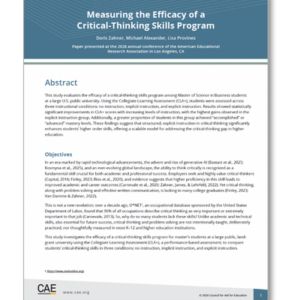
The results are clear, students who participate in our program show statistically significant improvements in their CLA+ scores and place higher value on their instructors and universities for helping them develop their higher-order skills (Zahner et al., 2026).
Read the whitepaper to learn more about the impact of CAE’s program on student future readiness.