It has long been thought that the higher education experience inherently teaches people to analyze information, solve complex problems, and explain their ideas. Yet, only 53% of students exiting a university or college are proficient in critical thinking (Van Damme & Zahner, 2022). That is not because students can not learn to think critically, it is because most syllabi never explicitly teach these skills or give students opportunities to practice them.
Generative artificial intelligence (AI) is exposing the limits of that assumption. 90% of faculty surveyed by the American Association of Colleges and Universities say they are concerned AI will erode students’ critical thinking (AAC&U & Elon University, 2026), making it even more important to teach the higher-order skills needed to use AI effectively and responsibly.
The good news for faculty is that teaching critical thinking explicitly does not mean rebuilding a syllabus from scratch. It means embedding it into existing coursework and assignments. Here are three ways to do it.
1. Give students a process they can follow in any situation
Most students have never been taught that “critical thinking” actually consists of a set of steps. They have been told to “think critically” about a text or a case, but no one has broken that into parts they can practice and improve on.
CAE’s Critical Thinking Program allows faculty to intentionally teach critical thinking using a framework that scaffolds student learning.
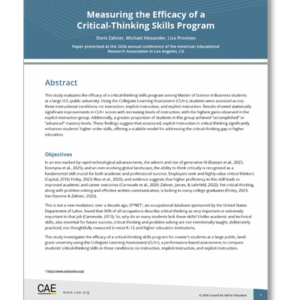
The research suggests that intentionally teaching a framework for critical thinking matters. A CAE study of 179 students in a one-year master’s program compared three groups: students who received no instruction in critical thinking, students whose faculty were trained on the framework and wove the ideas into teaching without explicitly teaching them, and students whose faculty taught the steps directly using in-class activities and performance tasks. Explicit instruction moved 83% of students into the Accomplished or Advanced range, compared with 69% for implicit instruction and just 21% for no instruction at all. More importantly, the percentage of students who were not proficient dropped to less than 1% compared to 13% in the implicit instruction and 34% in the no instruction condition. (Zahner, Alexander, & Provines, 2026).
In practice, this can be accomplished by adding a rubric or discussion prompt that walks through the steps, whatever the assignment already is: a written essay, a short-answer set, a debate, a quiz, an oral presentation. The point is not the assignment format. It is that students can point to a specific step such as “analyze the information” and know exactly which skill they are building and where they are falling short.
2. Place students in ambiguous situations
Traditional case studies tend to have a right answer waiting at the end. Real critical thinking happens when there is not one. A performance task presents students with an authentic scenario aligned with their course of study. They are presented with documents and data to sift through, competing stakeholders, and multiple equally defensible paths forward. Students have to define the problem, weigh the evidence, and defend their recommended course of action where there is not a clear correct answer, much like the real world.
This works across disciplines. A course in sociology could ask students to evaluate different options to address food insecurity among undergraduates, weighing budgets, access, student needs, and stakeholder input. An urban planning class may be faced with the question of whether or not a regional airport should expand the number of runways, examining the environmental and economic impacts. A communications course may reframe the question, “is AI good or bad?” to “what policy should our university implement to address the use of generative AI?” Cast students as a member of the student council faced with the decision of whether to recommend banning the use of AI outright and penalize its use, redesign courses to teach responsible AI use, or redesign them to prevent AI use altogether.
Performance tasks like these examples allow students to practice their critical thinking skills in a real-life scenario embedded in course content and provide opportunities for oral and written communications as well as group activities.
3. Take time for reflection
Analysis, argument, and communication often get most of the attention in a critical thinking assignment. However, actually stopping to think about your thinking, reflection or metacognition, rarely happens unless prompted.
CAE’s critical thinking framework treats reflection as its own distinct step. In practice, that can be as simple as a short set of questions students answer after finishing an assignment, rather than a separate activity: What is one thing about critical thinking you tried or noticed that you had not before? Which part of the process was hardest, and what would help you improve it? Where else, outside this assignment, could this same kind of thinking apply?
This reflection could be the closing paragraph of a written response, a short class discussion, or a group conversation. What matters is that students identify what they did and why, rather than just turning in the finished product and moving on. A student who can say “I noticed I was assuming X without checking it” has learned something that generalizes to the next assignment, the next job, and the next decision that is not about coursework at all.
A Research-Based Way to Incorporate Critical Thinking into Coursework
Individual assignments can help students develop their critical thinking skills but a department- or school-wide approach ensures that students receive consistent instruction in critical thinking and ample opportunities to practice and build their skills in every course. CAE’s Critical Thinking Skills Program is a comprehensive approach that includes faculty training, instructional materials, and performance-based assessments to create a robust system for skill development and measurement.
As your institution responds to the rise of AI and the shifting priorities of employers, integrating critical thinking skills instruction into your curriculum can play a key role in improving the workforce readiness of your students and boosting institutional value.
Read how Texas A&M’s Mays Business School has incorporated CAE’s Critical Thinking Skills Program into their curriculum and the impact it’s had on student outcomes. If you would like to learn more about the program and how CAE can support your institution’s goals, schedule a time to chat with us.