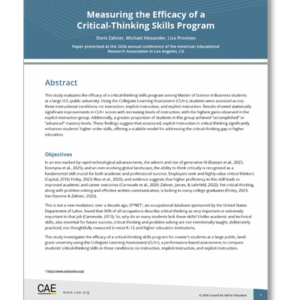
Generative AI continues to reshape careers and workplaces, offering efficiency and innovation in unprecedented ways. In parallel, research warns that overreliance on AI can weaken the essential, human-centric skills, including critical thinking, that are necessary to use this technology most effectively (Kosmyna, N. et. al, 2025).
Recognizing this need, 79% of employers seek candidates with strong critical thinking skills (Finley, A.P., 2023). Yet, only 53% of students achieve proficiency by graduation (Van Damme & Zahner, 2022).
Cultivating a student’s critical thinking skills requires intentional instruction and regular practice. When institutions embed critical thinking instruction into courses, it pays off in the classroom and in the workplace.
 1. Practical, real-world experience.
With CAE’s Critical Thinking Skills Program, students practice applying a framework to scenarios they may encounter in their careers. Engaging in real-world scenarios repeatedly prepares them to work through any critical thinking situation with greater confidence and skill.
 2. Evidence of Competencies
- For higher education institutions, structured, explicit instruction in critical thinking, paired with performance-based assessments such as the Collegiate Learning Assessment (CLA+), can be used to demonstrate program impact to employers, accreditors, and funders.
- For students, the results from these assessments, provide evidence of their proficiency for resumes and job applications.
 3. Preparation for career success.
The more adept students are with critical thinking, the better prepared they are for many career-related activities.
- Critical thinking skills help students respond confidently to interview questions that require them to provide a solution to a hypothetical workplace scenario.
- Even as a new employee, students who have strong critical thinking skills are ready on day one to analyze information, solve problems, and make informed decisions.
- As careers evolve at a rapid pace, critical thinking helps students adapt and continue to contribute to their organizations’ success.
 4. Deepened data and information literacy.
Students with proficiency in critical thinking are ready to question sources, evaluate claims, interpret data, and challenge assumptions. These skills are especially important when working with generative AI.
 5. Reflection and connection.
As students learn how to be more effective critical thinkers and communicators, these skills are instantly applicable to their daily lives, from long-term financial planning to navigating the complexities of relationships and more.
Invest in Students’ Critical Thinking Today for Their Success Tomorrow
CAE’s Critical Thinking Skills Program helps colleges and universities intentionally teach, practice, and measure the human-centric skills that give students an edge in an ever-changing workplace. Reach out to learn how we can help your faculty integrate critical thinking skills instruction into your courses.