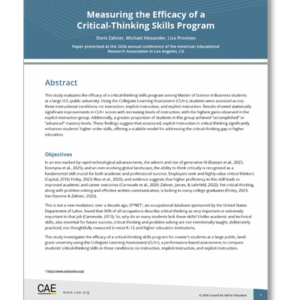
 Can teaching critical thinking also teach students to think more clearly about AI? This study, conducted at Tecnologico de Monterrey using CAE’s Seven-Step Critical Thinking Framework and scenario-based performance tasks, examines what happens when students reason first, then interrogate AI-generated responses to the same problem.
Key Insights:
- The study measured changes in students’ critical thinking across six dimensions aligned with the CAE Critical Thinking framework, using a mixed-methods pre/post design across two undergraduate courses.
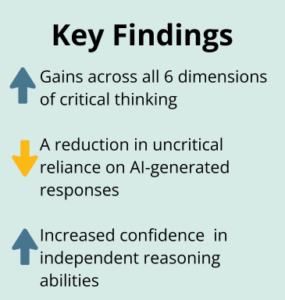
- Students showed statistically significant gains across all six dimensions of critical thinking in both courses (p < .01).
- When comparing their own work to AI-generated responses, students consistently found human-developed solutions to be more creative, nuanced, and willing to explore unconventional ideas.
- AI responses were data-rich but tended toward superficial, mainstream framing—a distinction students were able to identify and articulate.
- Students left the exercise with greater awareness of AI’s biases and limitations, and clearer norms for responsible AI use.
Why It Matters: As generative AI becomes a default tool in higher education, the ability to evaluate, not just use, AI is becoming an essential skill. This research offers evidence that structured critical thinking instruction can develop both capacities at once, with implications for faculty, curriculum designers, and institutional leaders navigating AI in the classroom.
Ready to Build Critical Thinkers on Your Campus?
CAE’s Critical Thinking Skills Program helps colleges and universities intentionally teach, practice, and measure the skills employers value most—and that AI can’t replicate. Reach out with questions or to discuss integrating critical thinking skills instruction into your courses.